
What is the vegetative phase?
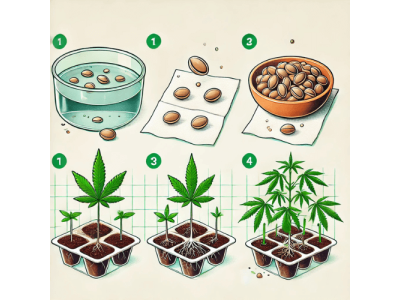
After initial development, the plant begins actively growing its above-ground portion. New leaves and lateral shoots form, the stem becomes stronger, and the roots begin to utilize the available substrate.
Outdoors, this period is naturally related to the season, when days become longer. In a controlled environment, the duration of light is artificially determined.
The rate of development varies in all cases. It is influenced by the origin of the source material, environmental conditions, root zone volume, and nutrient availability.
Why a good start doesn't start with fertilizers
Even the most sophisticated feeding program cannot compensate for weak starting material or unfavorable conditions.
Each breeding line has inherent characteristics. Care helps create the conditions for their expression, but cannot completely rewrite the original properties.
Therefore, when choosing collectible material, you should pay attention to the manufacturer, origin, and stated characteristics, and not just the loud numbers in the description.
What elements are important during active growth?
The basis of most complex fertilizers remains nitrogen, phosphorus, and potassium. But complete nutrition is not limited to just three NPK designations.
Calcium, magnesium, sulfur and small amounts of iron, boron, manganese, zinc, copper and other trace elements are also necessary.
Their functions differ, so it is more correct to talk about the overall balance, rather than about one “main” component.
Nitrogen and green mass
During the growing season, the role of nitrogen becomes especially noticeable. It participates in the formation of amino acids, proteins, and chlorophyll and is associated with the active development of green tissue.
But the principle of "more nitrogen, faster growth" doesn't work indefinitely. An excess of nutrient salts can be just as undesirable as a deficiency.
Therefore, it is necessary to evaluate the entire system: water composition, substrate, root condition and solution concentration.
The root system is the foundation for further development
The above-ground part attracts more attention, but a significant part of the important processes takes place where they are not visible.
Water and dissolved minerals enter the plant through the roots. The better developed the root zone, the more substrate it can utilize.
However, roots need more than just moisture to function properly. They also need oxygen. Constantly over-watered and compacted soil impedes air exchange and can cause problems even with sufficient nutrients.
Beneficial microorganisms in the root zone
The original Advanced Nutrients material places great emphasis on the bacteria and fungi used in its specialized supplements.
In a broader sense, substrate microbiology is indeed a part of nutrition. Beneficial microorganisms interact with the root system and participate in the transformation of organic compounds.
The role of such biological activity is especially noticeable in living soils and organic systems.
At the same time, the addition of a microbiological preparation does not replace the basic conditions: normal humidity, aeration and an appropriate environment.
Calcium and magnesium
Calcium is associated with the structure of cell walls and the development of young tissues. Magnesium is a central element of the chlorophyll molecule and is therefore directly involved in photosynthesis.
This is why both components are often found in nutrition programs.
However, Cal-Mag alone is not always necessary. Some of the required amount may be contained in the water or base fertilizer. Before applying additional fertilizer, consider the composition of the entire system.
Silicon and mechanical strength
The original program uses a separate source of silicon. This element is of interest primarily for its role in the formation of strong tissues and the response to abiotic stress.
In plant growing, silicon additives are used for various crops, although they should not be considered a universal stimulant.
The effect depends on the form of the substance, concentration and general condition of the culture.
Humic substances and algae extracts
Another category of components that can often be found in specialized preparations are humic substances and algae extracts.
They are used as part of comprehensive programs, not as a replacement for basic nutrition.
This is an important distinction. If basic macro- and micronutrients are deficient or the root zone is compromised, adding stimulants alone will not resolve the issue.
Enzymes and dead roots
The root system is constantly being renewed. Some of the old tissue naturally dies off, and new tissue forms in its place.
In a biologically active environment, organic residues gradually decompose. For this purpose, some applications use enzyme complexes designed to work with organic materials in the substrate.
But even here, one should avoid the logic of "the more additives, the healthier the roots." Initially, proper drainage, air exchange, and a suitable moisture regime are required.
Why pH Can't Be Ignored
The substrate may contain all the necessary elements, but this does not mean that they are still available to the roots.
The acidity of the environment affects the chemical form of individual components. In unfavorable conditions, a situation arises where a nutrient is present, but its absorption is impaired.
Externally, this may resemble a simple deficiency. If the answer is simply to increase the fertilizer concentration, the cause of the problem will remain.
Not every change of leaves means a lack of nutrition
Yellowing, drying out of the edges, elasticity or slow development can easily be attributed to a deficiency of a specific element.
However, similar symptoms can occur due to overwatering, acidity imbalances, high salt concentrations, root problems, temperature, or lighting.
Therefore, adding a new drug after every change in appearance is a bad strategy.
First, you need to check the basic conditions and only then draw conclusions about nutrition.
Why a complex design isn't necessarily better
The original material uses a variety of Advanced Nutrients products: a basic complex, bacteria, fungi, silicon, vitamin, enzyme and carbohydrate supplements.
For a commercial program, this structure is clear. But from an agronomic perspective, it's more important to understand the function of each component.
If a person can't explain why they're using a particular supplement, the regimen has probably already become more complicated than it needs to be.
A clear, basic system makes it easier to track reactions and find the cause of problems.
The relationship between the source material and the result
Fertilizers create conditions for the realization of inherent characteristics, but are not capable of transforming one breeding line into another.
Therefore, it is necessary to distinguish between two concepts: the potential of the source material and the conditions in which it develops.
The Sports Seeds catalog features collectibles from various origins. When choosing, you can compare the producer, type, parental lines, and stated characteristics, rather than relying on a single indicator.
What is important during the vegetative phase
- A balanced diet. The ratio of ingredients is important, not the maximum concentration.
- A healthy root zone. Roots need water, nutrients, and oxygen.
- pH control. Acidity affects the availability of individual elements.
- Stable conditions. Sudden environmental changes create additional stress.
- Careful diagnosis. Leaf color change does not always indicate a deficiency.
- Moderate use of additives. Each additional component should have a clear purpose.
The vegetative stage forms the basis for further development. During this period, roots, stems, shoots, and leaves actively grow, so a stable environment and balanced nutrition are especially important.
However, more products does not automatically mean better results. Basic macro- and micronutrients, normal root function, proper pH, and proper moisture are more important than a long list of stimulants.
Potential begins even earlier—with the characteristics of the source material. Care helps realize these, but it can't create something that wasn't initially intended by selection.
FAQ
What happens during the vegetative stage?
Leaves, shoots, stems, and the root system are actively developing. This is a period of intense growth of vegetative mass.
Which element is most important during vegetation?
It's incorrect to single out just one. Nitrogen is essential for green tissue, but phosphorus, potassium, calcium, magnesium, and trace elements are also required.
Are root stimulators necessary?
Special products may be part of a specific system, but they do not replace proper humidity, aeration, temperature and basic nutrition.
Do I need to use many different supplements?
Not necessarily. It's much more important to understand the composition of the base complex and each additional component.
Why do leaves turn yellow even when there is fertilizer?
A nutrient deficiency isn't always the cause. Root condition, substrate moisture, pH, and overall solution concentration should be considered.